Submitting a dissertation, thesis, or research paper means citing every source correctly, and that is often where the stress begins. APA referencing style (American Psychological Association) is the most widely used citation standard in academic writing: it defines precisely how to mention your sources within the text and how to list them in your bibliography.

This complete guide covers all the rules of APA 7th edition, with concrete examples for every case (book, website, journal article, video, thesis) and practical tips to avoid the most common mistakes. Whether you are a student preparing your first essay or a researcher finalizing a paper, everything you need is here.


What you need to know at a glance:

  • APA referencing style (7th edition) is the most widely used academic citation standard worldwide, applicable to dissertations, theses, lab reports, and scientific articles in social sciences, education, and health.
  • In APA 7, every in-text citation follows the (Author, Year) format and links to a full reference in the bibliography, listed alphabetically with a 1.25 cm hanging indent.
  • To apply APA formatting guidelines without errors, tools like Zotero or ZoteroBib automatically generate references in the correct format (always verify manually for unusual sources).
  • Before submitting your work, a plagiarism checker helps ensure no source has been forgotten or incorrectly referenced in your final document.


Table of Contents:
  1. What is APA referencing style?
  2. How to cite sources in APA format (in-text citations)
  3. APA bibliography: how to reference each source type
  4. APA title page: how to format it correctly
  5. APA formatting guidelines: fonts, margins, and spacing
  6. Tools to apply APA referencing easily


What is APA referencing style?


Definition of APA referencing style

APA referencing style is a set of citation and formatting rules developed by the American Psychological Association. It specifies how to acknowledge your sources within the body of your text and how to list them in a bibliography at the end of your document. The goal is simple: allow any reader to trace back the origin of any piece of information.

Today, APA referencing goes far beyond psychology. It has become the standard in many academic disciplines: social sciences, education, economics, and health. If your institution does not specify a particular citation style, APA is a safe and internationally recognised choice.


APA 7th edition: what changed

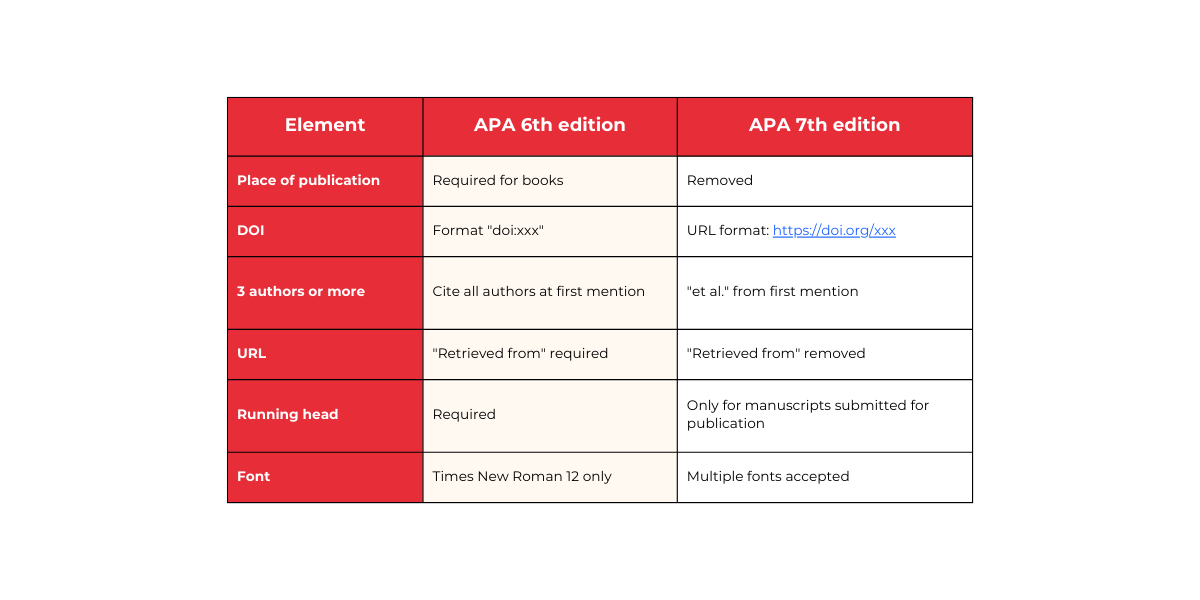
The current version is the 7th edition, published in 2019 by the American Psychological Association. It introduced several simplifications compared to the 6th edition, particularly for online sources and student papers. If your university does not specify which version to use, default to APA 7.

Comparison table APA 6th edition vs. APA 7th edition
APA citation illustration

When should you use APA referencing style?

APA referencing style applies to most academic work: dissertations, theses, lab reports, research papers, and scientific articles. It covers every source used during your research and writing process, whether that is a book, a website, a video, or a journal article.

One rule before you start: always check your institution's guidelines. Some universities impose a specific citation style, and using APA without verifying first can lead to penalties. Not the kind of surprise you want after weeks of work.

How to cite sources in APA format (in-text citations)


An in-text citation is a short reference placed directly after borrowed information. It tells the reader who wrote it and when, without interrupting the flow of reading. Every in-text citation must link to a full reference in the bibliography at the end of your document.

There are two forms of APA citation: the parenthetical citation and the narrative citation.

APA citation format illustration

Parenthetical citations

The parenthetical citation is placed after the relevant sentence. It includes the author's name and the year of publication, separated by a comma.

  • One author: (Dupont, 2021)
  • Two authors: (Dupont & Martin, 2021)
  • Three or more authors: (Dupont et al., 2021)

When quoting word for word, always add the page number: (Dupont, 2021, p. 45). If the source has no page number, use another locator such as a chapter or paragraph: (Dupont, 2021, Chapter 3).

For sources with no date, replace the year with "n.d.": (Dupont, n.d.). For sources with no identified author, place the document title in quotation marks followed by the date: ("Citation Guide", 2021).

APA narrative citation illustration

Narrative citations

The narrative citation integrates the author's name directly into the sentence, followed by the year in parentheses. Use it when you want to foreground the author rather than the information itself.

  • One author: Dupont (2021) argues that...
  • Two authors: Dupont and Martin (2021) show that...
  • Three or more authors: Dupont et al. (2021) confirm that...

For a word-for-word quote in narrative form, the page number follows the quotation: According to Dupont (2021), "the method proved its effectiveness" (p. 45).

Illustration of APA citation special cases

Special cases: et al., no author, no date

  1. Et al. in APA. "Et al." is the Latin abbreviation for "et alii", meaning "and others". In APA 7, use it from the first mention of a source with three or more authors, both in parenthetical and narrative citations. Important: "et al." always takes a full stop after "al." and is never written in italics.
  2. Source with no author. When no author is identified, replace the name with the document title, abbreviated if necessary and placed in quotation marks: ("Definition of neuropathy", 2023). In the bibliography, the title takes the place of the author at the start of the reference.
  3. Source with no date. When the publication date cannot be found, write "n.d." in parentheses in place of the year: (Dupont, n.d.). In the bibliography, "n.d." appears in parentheses at the usual position of the date.

Citing an organisation or institution

When the author is an organisation or institution, cite its full name at first mention, followed by its abbreviation in brackets if it has one. Subsequent mentions use only the abbreviation.

  • First mention: (National Institute of Health [NIH], 2023)
  • Subsequent mentions: (NIH, 2023)

For an organisation with no common abbreviation, always cite the full name: (Compilatio, 2023).

How to cite my sources in the bibliography using the APA format?


The bibliography lists every source cited in your work. It goes at the end of your document, after the conclusion. In APA referencing style, each entry follows a precise structure that varies by source type, but the logic is always the same: author, date, title, source.

A few formatting rules apply across the entire bibliography:

  • References are listed in alphabetical order by the first author's last name.
  • Each entry starts at the left margin, with all subsequent lines indented by 1.25 cm (hanging indent).
  • The title of the work or journal is always written in italics.
APA book citation illustration

How to cite a book in APA

The general rule: Last name, Initial(s). (Year). Title of the book. Publisher.

Example: Bourdieu, P. (1979). Distinction: A social critique of the judgement of taste. Harvard University Press.

For a book consulted online or in digital format, add the URL at the end of the reference. The place of publication is no longer required in APA 7, one of the most welcome simplifications from the 6th edition.


How to cite a book chapter in APA

When citing a chapter written by a different author from the book editor, list the chapter author first, then the chapter title, then the book title preceded by "In", framed by the relevant page numbers.

The rule: Last name, Initial(s). (Year). Chapter title. In Title of the book (pp. start–end). Publisher.

Example: Goleman, D. (2014). The art of getting along with others. In Emotional intelligence (pp. 17–19). Bantam Books.


How to cite a website in APA

The rule: Author or organisation. (Year, Day Month). Title of the page. Name of the site. URL.

Example: Compilatio. (2023, July 19). Cheating in the age of ChatGPT: findings and solutions. Compilatio. https://www.compilatio.net/en/blog/cheating-chatgpt

If the page is likely to be modified or removed, add the date of consultation in parentheses after the URL: (retrieved February 23, 2026). For pages with no identified author, the page title takes the place of the author at the start of the reference.

APA citation illustration of digital sources

How to cite a journal article in APA

The rule: Last name, Initial(s). (Year). Title of the article. Title of the journal, volume(issue), page start–page end. DOI or URL.

Example: Delmotte, S. (2009). Argumentation in knowledge access in digital publishing. Les Cahiers du numérique, 5(2), 53–84.

In APA 7, the DOI appears as a clickable URL: https://doi.org/example. If an article has no DOI but is available online, include the journal URL. If the article is only available in print, nothing is added after the page numbers.


How to cite a thesis or dissertation in APA

The rule: Last name, Initial(s). (Year). Title of the thesis or dissertation [Type of document and discipline]. University.

Example: Petricevic, A., & Talloir, V. (2019). Artificial intelligence: a solution for everyday decision-making? [Master's thesis in computer science]. Hardvard University.

For a thesis or dissertation consulted online via an institutional database, add the URL at the end. The document type in brackets specifies whether it is a doctoral thesis, a master's dissertation, or an undergraduate thesis.


How to cite a video or podcast in APA

The rule: Author or channel. (Year, Day Month). Title of the video or episode [Video or Podcast]. Platform name. URL.

Video example: Compilatio. (2022, October 11). Succeed in your studies without plagiarism with Compilatio Studium [Video]. YouTube. https://www.youtube.com/watch?v=8jt2Jfjaky8

Podcast example: Brown, B. (2020, January 14). The call to courage [Podcast]. Spotify. https://open.spotify.com/episode/example

If the video or podcast has no precise publication date, include the year only. For a podcast series, cite the specific episode, not the entire series.


APA source

How to cite a report or institutional document in APA

The rule: Authoring organisation. (Year). Title of the report. Publisher or organisation. URL.

Example: Department for Education. (2022). State of education report. DfE. https://www.gov.uk/government/organisations/department-for-education

When the author and publisher are the same organisation, do not repeat the publisher. This is common for government reports, university publications, and documents from international organisations such as UNESCO or the WHO.


Sources with missing information

It happens. A source is incomplete, a date is nowhere to be found, an author is anonymous. APA referencing style has a solution for every case:

  • No date: write "n.d." in parentheses in place of the year.
  • No title: briefly describe the document in brackets where the title would normally appear.
  • No author: place the title at the start of the reference.

No source is uncitable. That is one of the real strengths of APA 7.

APA title page: how to format it correctly


The APA title page is the first thing your reader sees. Get it wrong and the impression is set before they even reach your introduction. Get it right and it signals immediately: this student knows what they are doing.

APA 7th edition introduced a clear distinction between two types of title pages. Which one you need depends entirely on who you are writing for.


Student title page vs professional title page

APA 7 created a formal separation that the 6th edition never had:

  • The student title page is for course papers, dissertations, and theses submitted as part of academic study.
  • The professional title page is for manuscripts submitted for publication in a journal or academic review.

If you are a student, you need the student version. Simple as that.

illustration APA title page étudiant

What to include on a student APA title page

A correctly formatted student APA title page contains five essential elements:

  • Paper title: centred, bold, in title case, positioned in the upper half of the page.
  • Author name(s): first name, middle initial if applicable, last name. No titles (no "Dr.", no "Prof.").
  • Affiliation: the name of your university or institution, followed by the department.
  • Course information: course number and course name.
  • Due date: the date the paper is submitted, written in full (e.g. March 3, 2026).

No running head is required on a student title page in APA 7. That requirement disappeared with the 6th edition. One less thing to worry about.

illustration APA title page pro

What to include on a professional APA title page

A professional APA title page follows a different structure, designed for publication:

  • Paper title: centred, bold, in title case.
  • Author name(s): same rules as the student version.
  • Affiliation: institution and department for each author.
  • Author note: includes ORCID iDs, acknowledgements, disclosures, and a contact email.
  • Running head: a shortened version of the title (maximum 50 characters), appearing in the header of every page.

The running head is the key difference. It exists to identify the manuscript during the anonymous peer review process. If you are not submitting for publication, you do not need it.

APA title page formatting rules

Regardless of which version applies to you, the formatting rules are the same:

  • Font: Times New Roman 12pt, Calibri 11pt, or Arial 11pt.
  • Margins: 2.54 cm (1 inch) on all sides.
  • Line spacing: double-spaced throughout.
  • Page number: top right corner, starting at page 1 on the title page itself.

The title page counts as page 1. Always. A detail that trips up more students than you would expect.


The most common APA title page mistakes

Four errors come up again and again:

  • Adding "Dr." or academic titles before the author name. Not allowed in APA.
  • Forgetting the page number on the title page itself.
  • Using the running head format on a student paper. Only required for professional manuscripts.
  • Writing the title in all caps. Title case only: capitalise the first word and all major words.

Avoid these four and your title page is already better than most.

APA formatting guidelines: fonts, margins, and spacing

APA referencing style does not stop at citations. It also defines how your entire document should look. These formatting rules ensure optimal readability and the visual consistency expected in academic work.


Font, size, and spacing

In APA 7, several fonts are accepted, unlike the 6th edition which imposed Times New Roman 12pt across the board. The recommended options are Times New Roman 12pt, Calibri 11pt, Arial 11pt, or Georgia 11pt. Use one font throughout the entire document, bibliography included.

Line spacing must be double across the whole document: body text, citations, and bibliography. Margins are set at 2.54 cm on all four sides, which matches the default settings of most word processors.


Bibliography structure and formatting

The bibliography follows the same font and spacing rules as the rest of the document. Each reference starts at the left margin, with all subsequent lines of the same entry indented by 1.25 cm. This is called a hanging indent. References are listed in alphabetical order by the first author's last name, with no separation by source type.


How to apply APA formatting in Word

Word handles the main APA formatting parameters natively. Here is how to set them up in a few steps:

  • Font and size: select the entire document with Ctrl+A, then choose Times New Roman 12pt or Calibri 11pt.
  • Double spacing: select all, go to Home > Line Spacing, choose 2.0. Make sure "Space before paragraph" and "Space after paragraph" are both set to 0.
  • Margins: go to Layout > Margins > Normal. Word's default margins (2.54 cm) already match APA requirements.
  • Hanging indent: select your references, right-click > Paragraph > Special indent > Hanging > 1.25 cm.

Word also includes a built-in citation tool under References > Insert Citation. Use it with caution: its APA formats are not always up to date. Always verify manually or use a dedicated generator.

Create an effective bibliography
APA citation generator illustration

Tools to apply APA referencing easily

Mastering APA referencing rules is one thing. Applying them without errors across dozens of references is another. Two types of tools can save you considerable time: citation generators, which format your references automatically, and a plagiarism checker, which verifies that every source is correctly cited in your final document.


APA citation generators: which tools to use?

An APA citation generator takes the information from a source (title, author, date, URL) and produces a reference automatically formatted to APA 7 standards. Useful for avoiding formatting errors and saving time on your bibliography.

Among the most reliable free tools available, Zotero stands out as the reference: it is a bibliographic management tool that generates and organises citations in all referencing styles, including APA 7. It integrates directly with Word and most browsers. ZoteroBib is its online version, requiring no installation, ideal for occasional use.

Whichever tool you choose: always verify each generated reference manually. No tool is 100% reliable, particularly for unusual sources such as institutional reports or documents with missing information.


Compilatio Studium interface illustration - plagiarism and AI detector

Checking your citations with a plagiarism checker

Generating correct citations is the first step. The second is making sure no source has been forgotten or incorrectly referenced in your final document. That is where a plagiarism checker comes in.

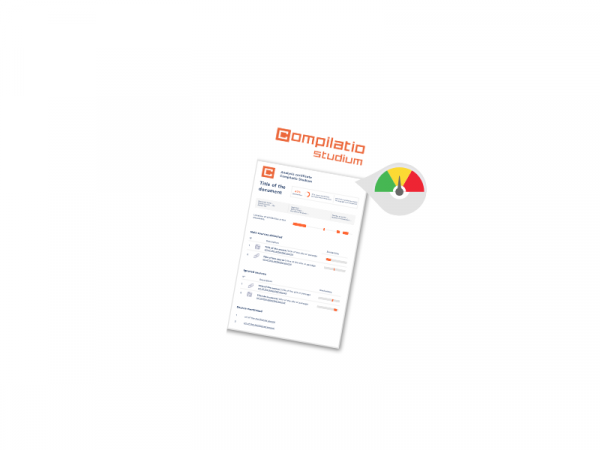
Compilatio Studium lets you verify the integrity of your work before submission. It analyses your document, detects similarities with existing sources, and identifies passages that need a citation or a rewrite. The results give you a clear picture of your references before your instructor does.

One thing worth knowing: documents analysed in Compilatio Studium are strictly confidential. They are not accessible to your teachers, even if they use Compilatio Magister. This is a tool built for students, not for surveillance.

Frequently asked questions about APA referencing style


What is APA referencing style?

APA referencing style is a set of citation and formatting rules developed by the American Psychological Association. It defines how to acknowledge sources within your text and how to list them in a bibliography. The current version is the 7th edition, published in 2019. It is one of the most widely used citation standards in the world, particularly in social sciences, education, psychology, and health. If your institution does not specify a style, APA is a safe and internationally recognised choice.

What is the difference between APA referencing style and Harvard referencing?

Both styles use an author-date format for in-text citations, which is why they are often confused. The key differences lie in the details. APA referencing style follows a strictly codified rulebook published by the American Psychological Association, updated regularly (currently in its 7th edition). Harvard referencing has no single official version: it varies by institution and country, which makes it less standardised. In practice, APA provides clearer rules for digital sources, missing information, and group authors. When in doubt, check which style your institution requires.

What is an APA title page?

An APA title page is the first page of your document, formatted according to APA guidelines. APA 7th edition distinguishes between two versions: the student title page (for course papers, dissertations, and theses) and the professional title page (for manuscripts submitted for publication). A student APA title page includes the paper title, author name, institutional affiliation, course information, and due date. No running head is required for student papers in APA 7, unlike in the 6th edition.

How do you use "et al." in APA referencing?

"Et al." is the Latin abbreviation for et alii, meaning "and others". In APA 7, use it from the first mention of any source with three or more authors, both in parenthetical and narrative citations: (Dupont et al., 2021) or Dupont et al. (2021). Two rules to remember: "et al." always takes a full stop after "al." and is never written in italics. In the bibliography, however, list all authors up to 20 names before switching to "et al."

What are the APA formatting guidelines for fonts and spacing?

APA 7 accepts several fonts: Times New Roman 12pt, Calibri 11pt, Arial 11pt, or Georgia 11pt. Choose one and use it throughout the entire document. Line spacing must be double across the whole paper, including the bibliography. Margins are set at 2.54 cm on all four sides. Each bibliography entry uses a hanging indent of 1.25 cm. These rules apply from the title page to the last reference.

What should you do if your source has no author or no date?

No source is uncitable in APA. Every missing element has a solution. No identified author: place the document title at the start of the reference, and use a shortened title in quotation marks for the in-text citation: ("Citation Guide", 2021). No publication date: replace the year with "n.d." (no date): (Dupont, n.d.). No title: briefly describe the document in brackets where the title would normally appear. These rules apply consistently in both in-text citations and the bibliography.

How do you cite a website in APA referencing style?

The rule is: Author or organisation. (Year, Day Month). Title of the page. Name of the site. URL.

Example: Compilatio. (2023, July 19). Cheating in the age of ChatGPT: findings and solutions. Compilatio. https://www.compilatio.net/en/blog/cheating-chatgpt

If no author is identified, the page title takes its place at the start of the reference. If the page is likely to change or be removed, add the retrieval date in parentheses after the URL.

Does a plagiarism checker verify APA referencing?

A plagiarism checker does not validate your citation format, but it does something equally important: it identifies passages in your document that match existing sources and flags anything that may need a citation or a rewrite. If a source appears in your text without a proper reference, the checker will catch it before your instructor does. Compilatio Studium analyses your document before submission and keeps your results strictly confidential. Think of it as a final check, not a surveillance tool.

Conclusion

Mastering APA referencing style is above all about giving yourself the means to submit work that is credible, rigorous, and compliant with your institution's requirements. Once the rules are assimilated (in-text citations, bibliography structure, special cases) citing your sources correctly becomes second nature.

And if you have made it this far, you are already ahead of most.

If your institution or discipline uses a different citation style, find our complete guides on MLA format, Chicago style, and Harvard referencing.


Sources used and cited according to the APA standard (bibliography) : 

Cite this article according to APA standards