How to Write a PEEL Paragraph (with Examples)
In short
- A PEEL paragraph makes one point and proves it: Point, Evidence, Explain, Link.
- It is the standard paragraph structure for essays at GCSE, A-level and university.
- It works for argumentative and analytical paragraphs alike; only the type of evidence changes.
Being right is not enough. You have to show it, in a few well-ordered sentences. That is exactly what the PEEL paragraph is for, whether you are analysing Macbeth, explaining a historical change or defending a position in a university essay. Here is the method step by step, five annotated examples built on real sources, and the mistakes that cost the most marks.
What is a PEEL paragraph?
A PEEL paragraph is a paragraph built in four moves: a Point that answers the question, Evidence that supports it, an Explanation of how the evidence proves the point, and a Link back to the question or on to the next paragraph. One paragraph, one idea, fully proved.
PEEL is a teaching acronym rather than a fixed rule, which is why you will also meet PEE, PEAL or CER (see the variants below). The logic stays the same: claim, prove, explain, connect.
You will use it throughout your studies:
- at GCSE and A-level, in English Literature, History, Geography, Religious Studies or Sociology essays;
- in middle and high school, where the same structure is often taught as CER;
- at university, where every body paragraph of an essay, report or dissertation follows the same logic, even if nobody calls it PEEL any more.
In an essay, each body paragraph is usually one PEEL paragraph. Three arguments mean three paragraphs, framed by an introduction and a conclusion.
PEEL paragraph structure
Every PEEL paragraph follows the same movement: an idea, the evidence for it, the reasoning that connects the two, and a return to the question.
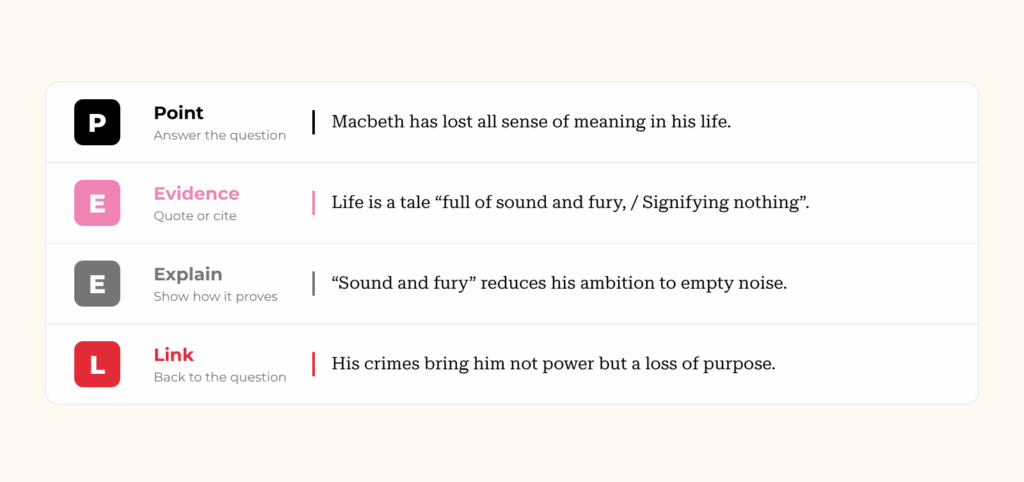
Point: state your argument
The first sentence states the idea you are defending, clearly and in direct response to the question. It should make sense on its own: an examiner who reads only your opening sentences should be able to follow your whole line of argument.
Evidence: back it up
Give specific, checkable support: a quotation, a date, an event, a named study, a statistic with its source. Vague evidence (“many people think”) is not evidence.
Explain: show how the evidence proves the point
This is where most marks are won or lost. In two or three sentences, explain what the evidence shows and why it supports your point. Connectives such as “this suggests”, “because” or “therefore” make the reasoning visible.
Link: connect back to the question
The final sentence returns to the question and says what the paragraph has established. In a longer essay, it can also prepare the next paragraph. Rephrase your point rather than repeating it word for word.
The same principle applies on a larger scale to a thesis introduction or a dissertation conclusion: every block has one clear job.
How to write a PEEL paragraph in 6 steps
- Decode the question. Underline the key terms and the command word (“analyse”, “explain”, “to what extent”). Misreading the question is the fastest route to an off-topic answer.
- Brainstorm in note form. Jot down what you know, what the sources say and any examples that come to mind. Keywords are enough at this stage, as with effective note-taking.
- Choose your strongest point. One paragraph carries one idea. Keep the one that answers the question most directly and for which you have the best evidence.
- Find precise evidence. Prefer a specific example to a general one, and note where it comes from: author, text, date, page.
- Write it in PEEL order. One sentence for the point, one or two for the evidence, two or three for the explanation, one for the link.
- Test every sentence. After each one, ask “so what?”. If a sentence does not move the argument forward, cut it.
Are your sources properly cited?
Compilatio Studium compares your text with billions of sources and highlights the passages to check. Make sure every quotation is in quotation marks and referenced before you hand in your work.
5 PEEL paragraph examples, annotated
Each example is labelled sentence by sentence: (P) Point, (E) Evidence, (Ex) Explain, (L) Link. Remove the labels and you have a paragraph ready to hand in.
English Literature example (analytical, GCSE)
Question: “How does Shakespeare present Macbeth’s state of mind at the end of the play?”
(P) By the final act, Shakespeare presents Macbeth as a man who has lost all sense of meaning in his life. (E) On hearing of his wife’s death, he describes life as “a tale / Told by an idiot, full of sound and fury, / Signifying nothing” (Act 5, Scene 5). (Ex) The image of a story told by an idiot suggests that events no longer follow any logic, while “sound and fury” reduces his own violent ambition to empty noise. The final word, “nothing”, isolated at the start of the line, captures the emptiness he now feels. (L) Shakespeare therefore shows that Macbeth’s crimes have not brought him power or satisfaction but a complete loss of purpose.
Why it works: the evidence is a short, exact quotation, and the explanation analyses specific words (“idiot”, “sound and fury”, “nothing”) instead of retelling the plot.
History example (A-level)
Question: “Explain why the state took responsibility for elementary education in late Victorian England.”
(P) One key reason was the growing belief that an expanding electorate needed to be educated. (Ex) The Reform Act of 1867 had extended the vote to many working men in towns, and politicians feared that voters who could not read would be unable to take part in public life responsibly. (E) Forster’s Elementary Education Act of 1870 created elected school boards to build schools wherever church provision was insufficient; the 1880 Act then made attendance compulsory from five to ten, and the 1891 Act made elementary schooling effectively free. (L) Within two decades, education had moved from a matter of charity to a duty of the state, closely tied to the extension of political rights.
Why it works: in History, evidence means precise dates, acts and actors. Here the explanation comes before the evidence; PEEL is a logic, not a rigid order.
Social sciences example (A-level Sociology)
Question: “Does the education system promote social mobility?” This paragraph qualifies the answer.
(P) However, schools only partly offset the inequalities linked to social background. (Ex) Pupils do not start on equal terms: those whose parents are highly educated are often more familiar with the language, cultural references and expectations that schools reward. (E) In Les Héritiers (1964), published in English as The Inheritors (1979), Pierre Bourdieu and Jean-Claude Passeron showed that students’ academic success depended heavily on the cultural capital passed on by their families, an advantage the education system tends to present as individual merit. (L) Education can therefore reproduce some of the inequalities it is meant to reduce, which limits its role as a driver of social mobility.
Why it works: “however” signals a counter-point, and the reference (authors, title, date) gives the argument real weight.
Philosophy example (A-level or first year)
Question: “Is work only a constraint?”
(P) Work is not merely a constraint, because it allows human beings to transform themselves. (Ex) In shaping material, the worker does more than make an object: they develop skills, learn patience and discover what they are capable of. (E) Hegel makes this point in the master and slave dialectic of the Phenomenology of Spirit (1807): the slave, forced to work for the master, comes to recognise himself in the objects he shapes, while the master, who only consumes, becomes dependent. (L) Far from being simple servitude, work can therefore become a path towards freedom.
Why it works: in Philosophy, evidence is often a reference to a thinker. It only counts if it is explained, as here.
University example (dissertation discussion)
Extract from the discussion chapter of a master’s dissertation in education (fictional data, for illustration).
(P) Our results suggest that detailed written feedback improves redrafting more than a mark alone. (Ex) Students who received targeted comments on how their paragraphs were organised restructured their texts more often, whereas those who received only a mark mostly made surface-level corrections. (E) In our sample, 18 of the 25 students in the first group changed the structure of at least one paragraph, compared with 7 of 24 in the second; this is consistent with Hattie and Timperley’s review of the effects of feedback (2007). (L) This finding needs to be confirmed with a larger sample, which we suggest as a direction for future research.
Why it works: at university, examiners expect quantified results, a link to the literature and an acknowledged limitation. To see where this fits in the whole project, read our guide on how to write a thesis.
PEEL for argumentative paragraphs
An argumentative paragraph uses PEEL to defend a position on a debatable question, such as “Should homework be banned?” or “Does social media harm democracy?”. The structure is identical; what changes is the evidence and the stance.
- In an analytical paragraph (English Literature, film, art), the point is an interpretation and the evidence comes from the text itself: quotations, techniques, structure.
- In an argumentative paragraph (debate, opinion essay, social sciences), the point is a claim and the evidence comes from the world: facts, studies, statistics, historical examples.
A strong argumentative paragraph also anticipates the opposing view. That is the job of the rebuttal paragraph, covered below.
Weak vs strong: one paragraph, two versions
The same idea can earn very different marks depending on how it is built. Question: “Does social media harm democratic debate?”
Weak version 👎
A paragraph that asserts without proving.
Social media is bad for democracy. There is a lot of fake news on it and everyone knows that. For example, there is often fake news. So social media is dangerous.
Strong version 👍
The same idea, built with PEEL.
(P) Social media can weaken democratic debate by helping unverified information spread. (Ex) Platform algorithms promote the content that generates the most reactions, and surprising or false claims often provoke more shares than nuanced ones. (E) A study published in Science in 2018 by three MIT researchers, Soroush Vosoughi, Deb Roy and Sinan Aral, found that on Twitter false news spread further and faster than true news. (L) Without source-checking, these platforms can distort public debate rather than inform it.
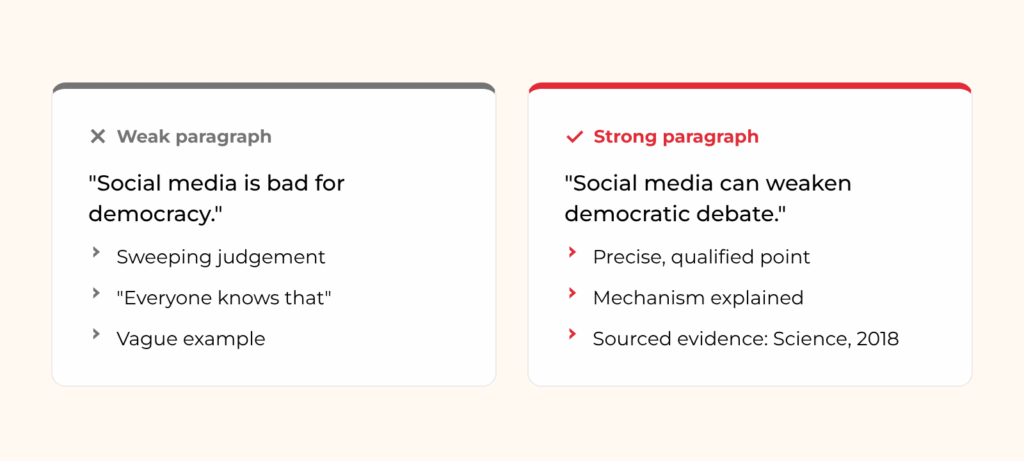
What changed:
- the point is precise and qualified (“can weaken”), not a sweeping judgement;
- the explanation describes a mechanism, instead of “everyone knows that”;
- the evidence is sourced (journal, year, authors), instead of a vague example;
- the link returns to the question, democratic debate, instead of drifting to “dangerous”.
PEEL, PEE, PEAL, CER: which paragraph method?
Different schools and countries use different acronyms for the same logic. Use the one your teacher or mark scheme expects: the steps barely change.
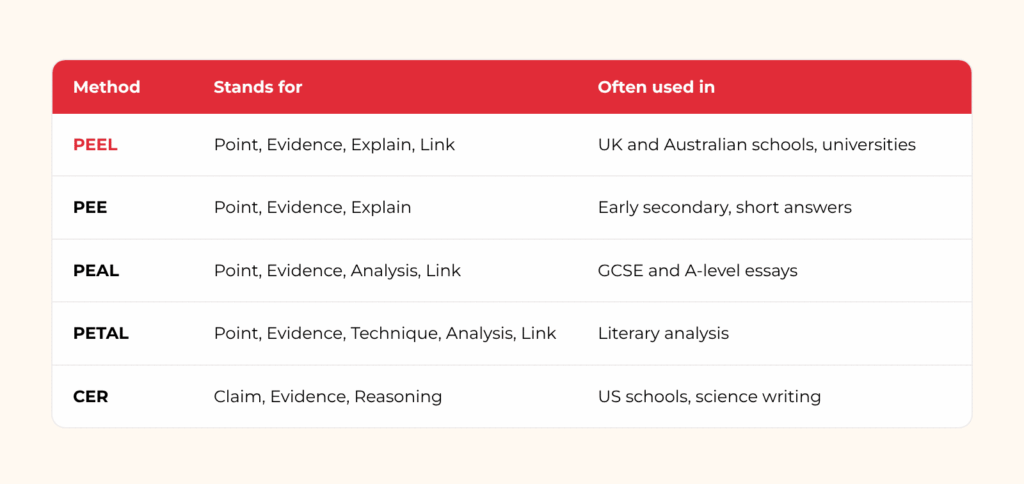
The main difference is the last step. PEE stops at the explanation, which suits short answers. PEEL and PEAL add the link, which keeps a longer essay coherent. PETAL adds the writer’s technique, essential in literary analysis.
Writing a counterargument and rebuttal paragraph
Definition
A rebuttal paragraph presents the strongest opposing view fairly, then shows its limits. It proves you have considered the debate, which examiners reward in argumentative essays.
A simple structure: concede (“admittedly”, “it is true that”), then counter (“however”, “yet”) with evidence, then conclude in favour of your position.
Question: “Should homework be banned?”
(Concession) Admittedly, homework can add stress and widen inequalities, since not every pupil has a quiet place to work at home. (Counter) However, banning it outright would remove a practice that research links to achievement, especially in secondary school. (Evidence) A meta-analysis by Harris Cooper, Jorgianne Civey Robinson and Erika Patall, published in the Review of Educational Research in 2006, found that the link between homework and achievement was clearly stronger for secondary pupils than for younger children. (Link) The answer is therefore to rethink homework, with shorter tasks and support at school, rather than to abolish it.
How to quote and cite evidence in a paragraph
Evidence only counts if your reader knows where it comes from. Three rules are enough:
- Introduce the source: author, text or document, and the date if it matters. “As George Orwell argues in ‘Politics and the English Language’ (1946)…”
- Quote briefly, in quotation marks: a well-chosen phrase carries more weight than a long extract. Our article on how to use quotation marks covers the details.
- Analyse the quotation: at least one sentence on what it shows and why it supports your point.
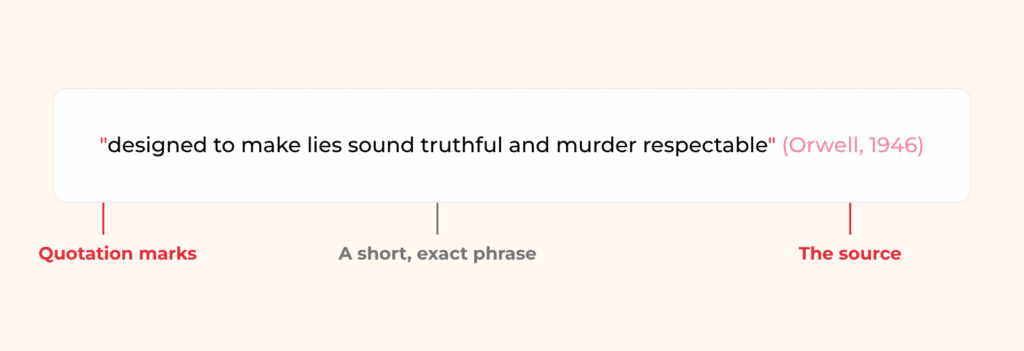
Example: As George Orwell argues in “Politics and the English Language” (1946), political language is often “designed to make lies sound truthful and murder respectable”: vague, abstract wording allows speakers to hide the reality of what they defend.
Putting an idea into your own words does not remove the need to credit its author: that is the whole point of paraphrasing without plagiarising. Facts that are genuinely common knowledge need no citation. At university, follow the style your institution requires, such as APA referencing; our guide to quotation rules compares the main ones.
Unsure about a quotation or a paraphrase?
With Compilatio Studium, you analyse your document before handing it in and spot passages that are too close to their sources. You stay in control: quotation marks, rewording or a reference, the choice is yours.
PEEL sentence starters and transition words
Sentence starters make each step of your paragraph visible. Choose them by function:
- Point: firstly, one reason why, a key factor is, it can be argued that.
- Evidence: for example, for instance, this is shown by, according to.
- Explain: this suggests that, this shows, because, which means that.
- Link: therefore, as a result, this demonstrates that, consequently.
- Counter-point: however, admittedly, on the other hand, nevertheless.
One starter per step is enough. Three “furthermore”s in one paragraph usually signal a list of ideas rather than an argument.
Common PEEL mistakes
Before handing in your work, check that your paragraph avoids these eight traps:
- Two ideas in one paragraph: split them, one idea per paragraph.
- A point that summarises the topic: it must answer the question, not describe the subject.
- Evidence with no explanation: add the sentence that says what it proves.
- An unsupported claim: “everyone knows” is not evidence.
- Overgeneralising: “all teenagers” becomes “many teenagers”, with figures to back it up.
- A quotation with no source: author, text and date, or the borrowing becomes a problem.
- A link that repeats the point word for word: rephrase and show what the paragraph has established.
- Retelling instead of analysing: in literature, explaining the plot is not analysis.
Using AI without losing your voice
An AI assistant can save you time while you prepare, as long as you keep what gives a paragraph its value: your choice of point and the way you defend it.
What AI does well:
- rephrasing a question to check you have understood it;
- suggesting counterarguments so you can practise rebutting them;
- reviewing the logical flow of a paragraph you have already written.
What should stay yours:
- your point, in other words your position on the question;
- your evidence and sources, to be checked every time, as an AI can invent a reference or a date;
- the final wording, in your own words.
If your assignment allows it, state how you used the tool. We cover good practice in our article on using AI responsibly. And if your own writing is flagged by an AI detector, here is what to do when your text is detected as AI.
Hand in work that sounds like you
Compilatio Studium identifies passages close to existing sources and those likely to have been generated by AI. You know exactly what to review before handing in your work.
FAQ about PEEL paragraphs
What does PEEL stand for?
PEEL stands for Point, Evidence, Explain (or Explanation), Link. It is a structure for writing paragraphs that make one point and prove it.
How long is a PEEL paragraph?
There is no official length: it depends on the task and the level. What matters is that the point is explained and supported. If your paragraph is only three sentences long, the explanation is probably missing.
What is the difference between PEE and PEEL?
PEE (Point, Evidence, Explain) stops after the explanation. PEEL adds a Link back to the question, which keeps longer essays focused and coherent.
Is a PEEL paragraph the same as an argumentative paragraph?
Not exactly. PEEL is a structure; an argumentative paragraph is a purpose. You can use PEEL to argue a position or to analyse a text. Only the type of evidence changes.
Can I use "I" in a PEEL paragraph?
It depends on the task. Some opinion pieces accept “I”, but most academic essays prefer an impersonal style (“this suggests”, “it can be argued”). Follow your assignment brief.
How do you start a PEEL paragraph?
With your point, phrased as a direct answer to the question. Avoid general openers such as “Throughout history…”, which delay your answer without proving anything.
Was this article helpful?

Jérémy STERN
Every day, I work on how content is created, detected and searched for online. On the Compilatio blog, I share my expertise on plagiarism, academic integrity and generative AI.